
Beyond the Steakhouse: How Clay Oven Cooking Brings a Different Kind of Grilling Home
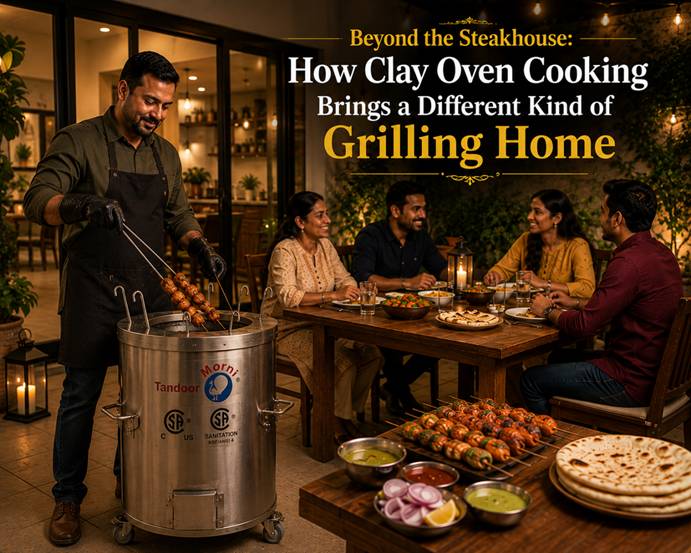
If you take grilling seriously, you’ve probably already worked your way through the usual progression. You started with gas. You switched to charcoal because you wanted more control over flavor. Somewhere along the way you tried a smoker, maybe even built yourself a wood-fired oven in the backyard. You own a meat thermometer and actually use it. You know the difference between direct and indirect heat without having to think about it, and you have strong opinions about which wood does what to smoke flavor.
This article is for that person — because there’s a cooking method a lot of serious home grillers still haven’t tried. It runs on completely different principles than anything in mainstream outdoor cooking, and for chicken, lamb, and flatbread in particular, it produces results nothing else can match. It’s called clay oven grilling, and people have been using it to cook some of the best grilled meat in the world for roughly five thousand years.
What a Clay Oven Actually Is (And What It Isn’t)
The tandoor — the traditional clay oven at the heart of South Asian and Middle Eastern cooking — isn’t just a clay version of your kitchen oven. It doesn’t cook the same way at all, and once you understand why, the rest of this makes a lot more sense.
A conventional oven, gas or electric, cooks with convected air. Hot air circulates around the food and slowly transfers heat into it. Even cranked up high, air is a fairly mediocre conductor of heat — which is exactly why it takes 30 to 45 minutes to roast a chicken in one. The heat is working its way through the air to reach the meat, and that takes time.
A clay oven skips that step. The clay walls soak up heat from the fuel underneath — charcoal or gas — until they hit somewhere between 800 and 900°F. At that point the clay itself starts radiating heat outward as infrared energy, in every direction at once. Food inside isn’t waiting on hot air to reach it; it’s absorbing radiant heat directly from a 900-degree wall. Think of the difference between sitting next to an open fire and sitting in a room with the heat on — both warm you, but not in the same way, and not at the same speed.
That difference is what makes clay oven cooking so fast and gives it such a distinct surface effect. A skewer of marinated chicken inside a tandoor is getting hit with radiant heat from every angle simultaneously, at a temperature that caramelizes the marinade almost on contact, chars the exterior, and seals the outside so quickly that the inside stays juicy in a way slower cooking methods just can’t manage.
Clay Oven Grilling vs. What You Already Know
Anyone who’s grilled chicken over charcoal knows the balancing act: you need enough heat to get real char, but too much and the outside burns before the inside catches up. You solve it with indirect heat, resting the meat off to the side, watching the thermometer. Done well, it’s excellent.
A 900-degree clay oven sidesteps that problem entirely. Because the heat is radiant and coming from every direction, the exterior hits char temperature fast while the interior is cooking through at the same time, from all sides. Bone-in chicken comes out done in 15 to 20 minutes at full tandoor heat — exterior charred and colored like the best thing off your grill, interior still moist because it simply didn’t have time to dry out.
Flatbread is where this really shows. Naan, lavash, the flatbread every grilling culture eventually invents — in a tandoor, the clay wall itself is the cooking surface. You press the dough straight onto the inner wall at 900°F and it’s done in under two minutes. The blistering comes from direct contact with fired clay, not a griddle or a grate, and neither does the char. Nothing else produces flatbread quite like it.
Seekh kebab — minced meat pressed onto flat skewers — solves a different problem the same way. Every griller who’s made these knows the risk: the outside has to firm up before the inside finishes cooking, or the meat slides right off the skewer. In a tandoor, the exterior sets almost instantly, locking the meat in place while the center cooks through, and you end up with a genuine crust that takes a grill far longer to build.
For anyone who’s already invested in a kamado or a ceramic smoker, the comparison is worth making. A kamado also cooks with radiant heat off ceramic walls — same underlying idea as a tandoor — but at much lower temperatures, usually 200–400°F for smoking and 600–700°F for high-heat work. Its strength is holding heat and moisture at low, slow temperatures. A clay tandoor’s strength is the opposite: extreme radiant heat, 800–900°F, hotter than any kamado gets, producing surface effects a kamado simply can’t. They’re not competing for the same job. A serious outdoor setup has room for both — kamado for the brisket and ribs, tandoor for the chicken, the lamb skewers, the flatbread. Knowing which tool earns which result is really what separates a good outdoor cook from a great one.
The Clay Itself — Why It Actually Matters
The clay isn’t incidental to any of this. Tandoori clay — the refractory clay used in both traditional and modern tandoor builds — is chosen specifically because it absorbs and holds heat at extreme temperatures, radiates it evenly across the whole cooking surface, and survives the repeated heating and cooling cycles without cracking apart. It’s a specialist material, not a stand-in for ceramic or metal, and the trace minerals in it, once heated, are part of where that faint earthy note in tandoor-cooked food comes from.
Looking after a clay oven — keeping the interior sealed, catching hairline cracks early, re-seasoning it after it’s sat unused for a while — is part of the relationship, the same way maintaining a cast iron skillet is. Take care of the clay and it keeps performing.
Taking It Mobile
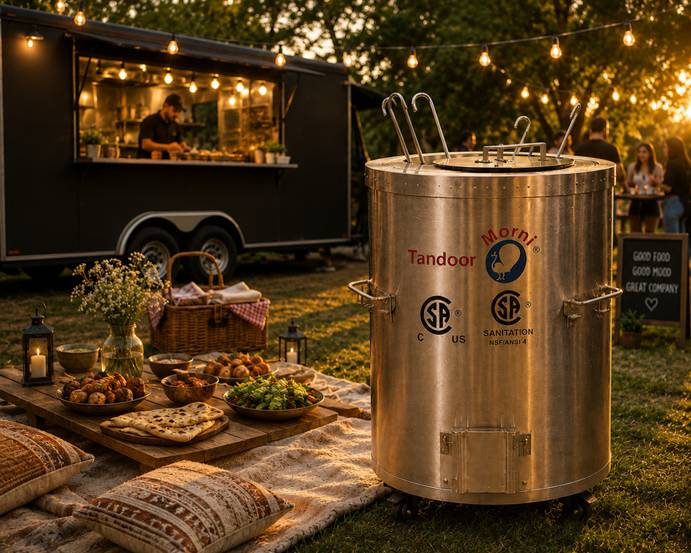
For anyone who cooks outdoors regularly, a portable clay oven is an easy sell. A Mobile Food Truck Oven — compact, built to travel, certified for catering and mobile food service — runs on the exact same clay-and-heat principles as a fixed tandoor, just wherever you need it. For home cooks who entertain, that means real clay oven grilling at a backyard party, a tailgate, a hunting camp, anywhere you’d normally haul out a grill. And it’s not a watered-down version of the fixed setup — same clay, same temperatures, same physics, just on wheels.
What Clay Oven Grilling Actually Gets You
If you’ve already worked through the mainstream grilling methods, a clay oven isn’t here to replace any of it. It’s a different tool that does things your current setup can’t. Your grill is still the right call for steak, burgers, most of what you’d cook over open flame. The tandoor earns its place for chicken you want done in 15 minutes with real exterior char, for skewer dishes that need the outside to set instantly, and for flatbread you want ready in under two minutes off a 900-degree clay wall.
People who add a clay oven to their setup tend to say the same thing: it doesn’t replace what they were already doing well, it opens up a category of result they simply couldn’t get before. If you’ve spent years figuring out what high-heat cooking is capable of, this is the next step past what standard grilling gear can offer.
A serious outdoor cooking setup looks a little different once a clay tandoor is part of it. The grill still does what grills do best — high-heat searing for steaks, burgers, fish that need direct flame. The smoker or kamado still owns the slow stuff — brisket, pork shoulder, ribs that need hours of low heat and smoke. And the clay tandoor covers the high-heat radiant cooking neither of the others can touch: skewer work, flatbread, chicken at 900 degrees. Each one owns its own lane. The tandoor’s lane — extreme radiant heat — is the one most serious outdoor cooks haven’t explored yet, mostly because good equipment for it hasn’t been easy to find until fairly recently.
That’s changing now. Certified home tandoors from established manufacturers have made this format accessible without cutting corners on the physics behind it. If you’ve already put real time and money into an outdoor kitchen you’re proud of, a clay tandoor is the logical next addition — not because it makes everything better, but because it does things nothing else in your setup can.
